Hours of Service (HOS) Rules Cheat Sheet for 2026
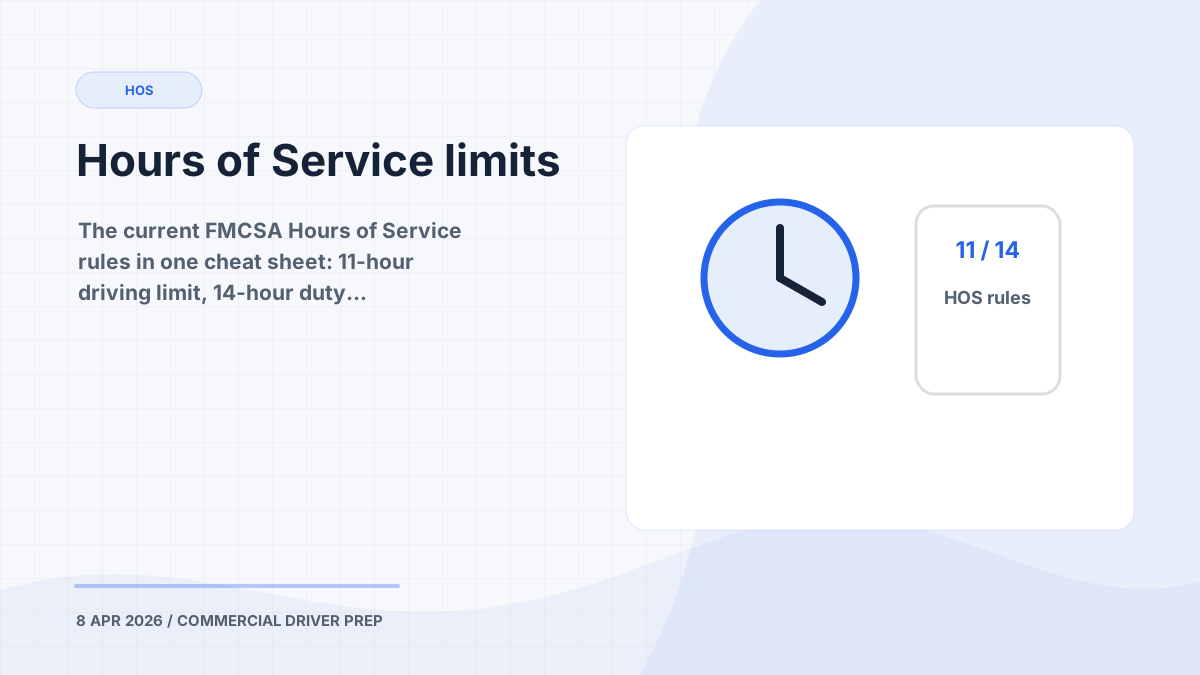
The current FMCSA Hours of Service rules in one cheat sheet: 11-hour driving limit, 14-hour duty window, 30-minute break, 60/70-hour rule and split-sleeper.
The Hours of Service rules are the most-checked FMCSA regulation on roadside inspections. Knowing them is mandatory for the CDL knowledge test, and living them is the difference between a clean ELD and an out-of-service violation.
Here’s the 2026 cheat sheet — the same logic powers the HOS Quick Check field tool inside our CDL Test app.
The four core limits (for property-carrying drivers)
| Rule | Limit | Resets with |
|---|---|---|
| Driving limit | 11 hours of driving | 10 consecutive hours off |
| Duty window | 14 hours from first on-duty time | 10 consecutive hours off |
| 30-minute break | Required after 8 hours of driving | 30 min non-driving (any status) |
| Weekly limit | 60/7 or 70/8 hours of on-duty time | 34+ consecutive hours off |
The simple way to remember: 10-11-14. 10 hours off resets you. 11 hours of driving allowed. 14 hours from start to finish in your duty window.
The 14-hour clock — when it starts and what stops it
The 14-hour window starts the moment you go on-duty. It runs continuously and cannot be paused unless you use the split-sleeper provision.
What counts as on-duty:
- Driving
- Loading and unloading
- Inspecting / servicing the vehicle
- Fuelling
- Time spent in or near a vehicle if available to work (even when not driving)
- DOT physical exams or drug tests
What doesn’t count as on-duty:
- Time off-duty in the truck without responsibility for it
- Sleeper-berth time
- Personal conveyance (with caveats — see below)
The split-sleeper berth option
Drivers can split their 10-hour rest into:
- 8 hours in the sleeper berth (uninterrupted)
- 2 hours off-duty or in the sleeper berth
The two periods together must add up to 10 hours. The 8-hour block does not count against the 14-hour duty window — but the 2-hour block does. This lets long-haul drivers find legal rest at irregular times.
Tip: The split-sleeper math gets confusing fast. The HOS Quick Check tool in our CDL Test app computes the next legal split automatically.
The 60/70-hour cycle (a.k.a. the weekly clock)
Two variants:
| Cycle | Days | On-duty cap | Best for |
|---|---|---|---|
| 60/7 | 7 days | 60 hours total | Carriers not operating every day |
| 70/8 | 8 days | 70 hours total | Carriers operating every day |
Both cycles can be reset by taking 34 or more consecutive hours off duty (“34-hour restart”). Once you restart, the rolling cycle is wiped clean.
The 30-minute break
After 8 cumulative hours of driving time, drivers must take a break of at least 30 consecutive minutes in any non-driving status:
- Off-duty
- Sleeper berth
- On-duty not driving (e.g., waiting at a dock)
The break doesn’t extend the 14-hour clock — except in the case of sleeper berth time used as part of a split.
Personal conveyance — the high-risk exception
Personal conveyance is off-duty driving time for the driver’s personal benefit. You can use it to:
- Drive from a shipper’s lot to a nearby restaurant or motel
- Commute home in a truck after delivery
- Move to find a safe rest area for required HOS rest
You cannot use personal conveyance to:
- Move closer to your next pickup
- Drive an in-service load (even a few miles)
- Move toward a delivery point to save time the next day
Did you know? PC is the most-cited HOS abuse in roadside audits. The vehicle must be empty (or your delivery complete) and the movement must clearly benefit the driver, not the carrier. Inspectors will check ELD comments — vague PC notes are red flags.
Two special exceptions
Short-haul (the “100 air-mile” rule)
A driver who returns to the work-reporting location and is released from work within 14 hours, operating within a 150 air-mile radius, is exempt from logging duty status with an ELD. But they still cannot exceed the 11-hour driving limit.
Adverse driving conditions
If unforeseen weather, road closures, or unforeseen traffic make safe completion of the trip impossible, drivers may extend the 11-hour and 14-hour limits by up to 2 hours.
This must be documented on the log — and “I left late” is not adverse conditions.
How the test asks HOS questions
The CDL General Knowledge test typically has 5–10 questions on HOS. They usually test:
- The 10-11-14 numbers (most common)
- What counts as on-duty vs. off-duty
- The 30-minute break trigger
- Personal conveyance permissions
- The 34-hour restart rule
Remember: Every state DMV uses HOS questions drawn from the CDL Manual Section 2.6 — even if the FMCSA rule has been revised more recently. Always study the current state manual + FMCSA rule together.
The HOS Quick Check tool
The CDL Test app’s HOS Quick Check tool takes your last 10 days of driving, breaks, and rest, and shows:
- Drive time available before you hit 11 hours
- Time remaining in the 14-hour window
- Whether you can take a 30-minute break legally
- Hours left in the 60/70-hour cycle
- Next legal restart time
It’s the same logic the federal ELD audits use.
Putting HOS to work
Knowing the rules on the test is one thing. Applying them on a Tuesday at 2am when dispatch is pressuring you to “just deliver early” is another. The cleanest defense against an HOS violation is knowing what’s legal cold.
Frequently asked questions
When does the 14-hour clock start?
Can I take my 30-minute break in the sleeper berth?
What's the difference between the 60-hour and 70-hour rule?
Does personal conveyance count toward HOS?
Related apps
Put what you've read into practice
Free practice quizzes for CDL, HazMat and Air Brakes — no signup.